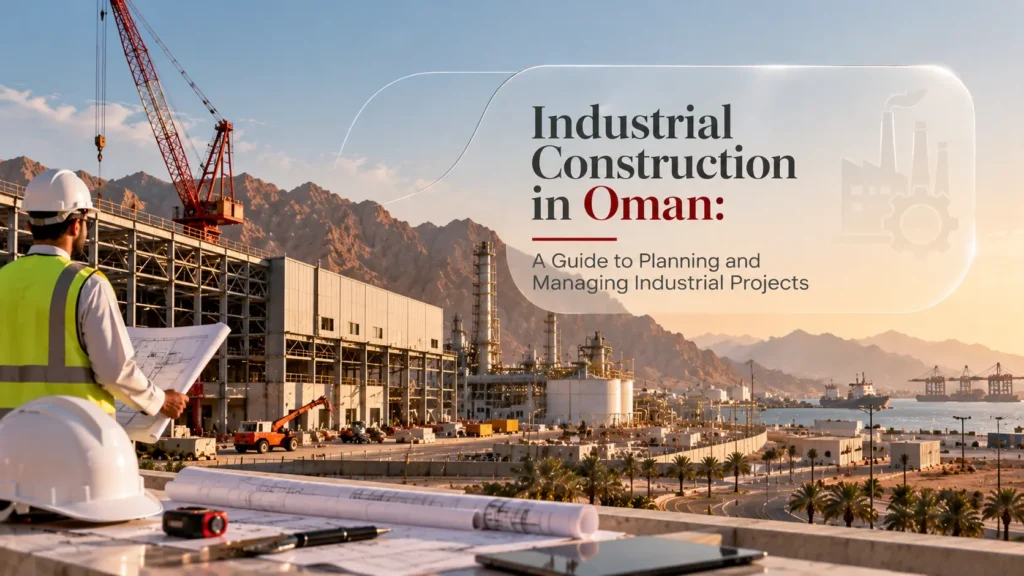
Industrial development is an important part of Oman’s growing economy, creating demand for reliable and well-planned industrial facilities, warehouses, commercial-industrial buildings, and specialized construction projects.
Unlike residential or standard commercial buildings, industrial construction in Oman often requires a higher level of technical coordination, planning, safety management, material selection, and project control.
Industrial projects may involve large-scale structures, specialized equipment, production areas, storage facilities, electrical and mechanical systems, access requirements, and strict operational considerations. As a result, choosing an experienced construction partner is essential for maintaining quality, safety, efficiency, and project timelines.
This guide explains the key factors involved in industrial construction in Oman, from planning and site preparation to construction, quality control, safety, and final project handover.
What Is Industrial Construction?
Industrial construction refers to the planning, development, and construction of buildings and facilities designed for industrial or operational purposes.
Depending on the business and project requirements, industrial facilities can include:
- Warehouses
- Manufacturing facilities
- Production buildings
- Industrial offices
- Storage facilities
- Workshops
- Distribution facilities
- Commercial-industrial buildings
- Specialized operational spaces
Industrial construction requires more than creating a functional building. The facility must support the way the business operates.
The building layout, access, storage areas, equipment requirements, utilities, safety systems, and workflow should therefore be considered during the planning stage.
Why Is Industrial Construction in Oman Different?
Industrial projects can have more complex requirements than many residential developments.
A typical industrial project may need coordination between:
- Architects
- Structural engineers
- Mechanical engineers
- Electrical engineers
- Contractors
- Suppliers
- Equipment providers
- Safety teams
- Project managers
- Consultants
The construction team must also consider how the finished facility will function after completion.
For example, a warehouse may require specific loading areas, vehicle access, storage heights, circulation routes, ventilation, lighting, and fire-safety provisions.
A manufacturing facility may have additional requirements related to production equipment, utilities, workflow, electrical capacity, and specialized spaces.
This makes professional planning particularly important.
Key Stages of an Industrial Construction Project
A successful industrial development should follow a structured process.
Initial Project Assessment
The first stage is understanding the client’s business requirements and the purpose of the facility.
Important questions include:
- What will the building be used for?
- What equipment will operate inside?
- How many employees will use the facility?
- What type of storage is required?
- What vehicle access is needed?
- What utilities are required?
- What are the expected future expansion requirements?
Understanding these requirements at the beginning can help prevent costly changes later.
Site Evaluation and Planning
The construction site needs to be evaluated before construction begins.
Site planning may consider:
- Site access
- Ground conditions
- Building orientation
- Vehicle movement
- Loading and unloading
- Parking
- Utility connections
- Drainage
- Storage areas
- Emergency access
- Future expansion
Proper site planning can improve both construction efficiency and the long-term operation of the facility.
Design and Engineering Coordination
Industrial facilities often require coordination between multiple engineering disciplines.
Structural design must work together with architectural, mechanical, electrical, and operational requirements.
At this stage, the project team should identify potential conflicts before construction begins.
Good coordination can reduce:
- Design changes
- Construction delays
- Material waste
- Rework
- Installation problems
Construction
Once planning and approvals are completed, construction can begin.
Depending on the project, construction may include:
- Site preparation
- Foundations
- Structural works
- Building envelope
- Roofing
- Flooring
- Electrical works
- Mechanical systems
- Plumbing
- Internal finishes
- External works
The construction sequence should be carefully coordinated to maintain project efficiency.
Quality Inspection and Handover
Quality control should continue throughout the construction process.
Before handover, the completed facility should be inspected to ensure that construction work meets the approved project requirements.
Final activities can include:
- Inspection
- Testing
- Defect identification
- Corrections
- Documentation
- Final approval
- Client handover
What Types of Industrial Buildings Can Be Constructed in Oman?
Industrial construction covers a wide range of building types.
Warehouses
Warehouses are designed around storage, logistics, movement, and operational efficiency.
Important considerations can include:
- Storage capacity
- Ceiling height
- Loading bays
- Vehicle access
- Internal circulation
- Flooring
- Lighting
- Ventilation
- Security
A well-designed warehouse should support efficient movement of products and personnel.
Manufacturing Facilities
Manufacturing buildings require careful planning because the construction needs to support production processes.
The layout may need to accommodate:
- Production lines
- Machinery
- Raw materials
- Finished products
- Staff areas
- Maintenance areas
- Electrical systems
- Mechanical systems
The construction team should understand the operational requirements before finalizing the building layout.
Industrial Offices
Many industrial developments combine operational facilities with offices and administrative spaces.
These areas may include:
- Management offices
- Meeting rooms
- Reception areas
- Employee facilities
- Administrative spaces
- Training rooms
The office component should be integrated into the overall facility without disrupting industrial operations.
Workshops and Specialized Facilities
Workshops and specialized facilities can require additional planning based on the activities taking place inside the building.
Requirements may include:
- Heavy-duty flooring
- Equipment access
- Ventilation
- Electrical capacity
- Storage
- Workshop areas
- Safety systems
Important Factors to Consider Before Starting an Industrial Project
Industrial construction requires careful planning before work begins.
Project Requirements
The first step is defining exactly what the facility needs to accomplish.
A clear project brief should cover:
- Building function
- Required capacity
- Operational requirements
- Space requirements
- Equipment
- Storage
- Access
- Employee areas
- Future expansion
Budget
The construction budget should consider more than the cost of the building itself.
Potential costs can include:
| Cost Area | Examples |
|---|---|
| Site Preparation | Groundwork and site development |
| Structure | Foundations and structural systems |
| Building Envelope | Walls, roofing and external elements |
| Electrical | Power, lighting and electrical systems |
| Mechanical | HVAC and mechanical requirements |
| Plumbing | Water and drainage systems |
| Safety | Fire and safety requirements |
| External Works | Roads, parking and access |
| Equipment | Specialized industrial equipment |
| Finishing | Flooring, walls and internal finishes |
A detailed project scope can help reduce unexpected costs during construction.
Timeline
Industrial projects can involve multiple construction stages and suppliers.
A realistic timeline should consider:
- Design
- Approvals
- Procurement
- Material delivery
- Site preparation
- Structural construction
- MEP works
- Equipment installation
- Testing
- Final inspection
- Handover
The earlier potential delays are identified, the easier it is to manage them.
The Importance of Project Management in Industrial Construction
Project management is particularly important for industrial developments because multiple activities can take place simultaneously.
An experienced project management team can coordinate:
- Contractors
- Subcontractors
- Suppliers
- Consultants
- Engineers
- Materials
- Equipment
- Construction schedules
- Quality inspections
- Safety procedures
Effective coordination can help prevent conflicts between different construction activities.
For example, electrical or mechanical installation may depend on structural work being completed first. Poor scheduling can therefore create delays across multiple parts of the project.
Quality Control in Industrial Construction
Quality control should be integrated into every stage of an industrial project.
Important areas include:
Material Inspection
Construction materials should be checked before and during installation to ensure they meet project specifications.
Structural Quality
Structural elements are critical to the safety and long-term performance of the facility.
Installation Quality
Mechanical, electrical, plumbing, and other systems should be installed according to the approved requirements.
Finishing Quality
Floors, walls, ceilings, doors, roofing, and other finishing elements should be inspected before completion.
Final Testing
Systems should be tested before the facility is handed over to the client.
A structured quality-control process can reduce the risk of defects and expensive corrective work after completion.
Safety in Industrial Construction Projects
Safety is one of the most important considerations in industrial construction.
Industrial sites may involve:
- Heavy machinery
- Construction equipment
- Vehicles
- Electrical systems
- Elevated work
- Heavy materials
- Multiple construction teams
A professional construction company should therefore establish clear safety procedures throughout the project.
Important safety practices can include:
- Worker orientation
- Safety training
- Personal protective equipment
- Site inspections
- Risk assessments
- Safe equipment operation
- Site organization
- Emergency procedures
- Ongoing safety monitoring
Mushtaq Ahmed LLC states that safety is incorporated into its work plans and includes employee orientation, ongoing training, and regular on-site inspections.
How Technology Can Improve Industrial Construction
Modern construction technology can improve project planning, coordination, and efficiency.
Depending on the project, technology can support:
- Digital project management
- 3D design
- Building information coordination
- Digital documentation
- Construction scheduling
- Site monitoring
- Quality tracking
- Progress reporting
Technology can help project teams identify potential issues earlier and improve communication between different stakeholders.
Why Experience Matters in Industrial Construction in Oman
Industrial projects can be technically demanding, and experience can help construction teams anticipate challenges before they become major problems.
An experienced construction partner can bring knowledge of:
- Construction planning
- Site coordination
- Material procurement
- Project scheduling
- Quality control
- Safety management
- Contractor coordination
- Project handover
Mushtaq Ahmed LLC has experience across commercial and industrial construction, as well as new construction, renovations, tenant improvements, and start-up projects.
The company also states that it has more than 40 years of presence in Oman’s construction industry and has completed and delivered more than 200 projects.
For more information about the company’s capabilities, visit its construction solutions page.
How to Choose an Industrial Construction Partner in Oman
Choosing the right construction partner should be based on several factors rather than price alone.
Review Previous Projects
Look for projects that demonstrate experience with similar building types and technical requirements.
The company’s project portfolio can help you evaluate its previous construction experience.
Evaluate Technical Capabilities
Make sure the contractor can coordinate the engineering and construction requirements of your project.
Check Safety Procedures
Ask how safety is managed and monitored throughout construction.
Understand the Construction Process
A clear construction process makes it easier to understand how the project will move from planning to completion.
You can review the construction process to understand the stages involved in structured project delivery.
Evaluate Communication
Clear communication between the client and construction team can reduce misunderstandings and help resolve issues faster.
Compare Overall Value
Do not compare contractors based only on the initial quotation.
Consider:
| Evaluation Factor | Importance |
|---|---|
| Industrial Experience | High |
| Technical Capability | High |
| Previous Projects | High |
| Project Management | High |
| Safety | High |
| Quality Control | High |
| Communication | High |
| Timeline Management | High |
| Price | Important |
Industrial Construction in Oman and Long-Term Business Value
An industrial facility is more than a physical structure. It is an environment where a business operates, stores products, manages employees, and serves customers.
This means construction decisions can influence the business for many years.
A well-planned facility can potentially improve:
- Operational efficiency
- Storage capacity
- Employee workflow
- Safety
- Maintenance
- Energy performance
- Future expansion
- Business scalability
For this reason, industrial construction should be approached as a long-term investment rather than simply a building project.
Why Work With Mushtaq Ahmed LLC?
Mushtaq Ahmed LLC combines construction management and general contracting capabilities with experience across Oman.
The company highlights experience in commercial and industrial construction and provides customized solutions based on project requirements.
Its capabilities include project management, construction, renovation, tenant improvements, and other construction services.
The company also states that it has:
- More than 40 years of presence in Oman’s construction field
- More than 20 years operating as Mushtaq Ahmed LLC
- More than 240 skilled laborers
- More than 200 completed and delivered projects
You can learn more about the company’s background through the About Us page.
Frequently Asked Questions About Industrial Construction in Oman
What is industrial construction?
Industrial construction involves designing and building facilities used for manufacturing, storage, production, logistics, workshops, and other industrial or operational purposes.
What types of industrial buildings can be constructed in Oman?
Industrial construction can include warehouses, manufacturing facilities, workshops, industrial offices, storage facilities, distribution centers, and specialized operational buildings.
How long does an industrial construction project take?
The timeline depends on the size, complexity, design, approvals, materials, equipment requirements, site conditions, and construction scope of the project.
How much does industrial construction in Oman cost?
There is no fixed price because costs depend on factors such as building size, structural requirements, materials, mechanical and electrical systems, site conditions, finishes, equipment, and external works.
Why is project management important for industrial projects?
Industrial projects involve multiple teams, suppliers, consultants, materials, and construction activities. Strong project management helps coordinate these elements and reduce delays and conflicts.
What should I consider before building an industrial facility?
Important considerations include the purpose of the facility, site conditions, building layout, operational requirements, equipment, utilities, access, safety, budget, timeline, and potential future expansion.
Why is safety important in industrial construction?
Industrial construction can involve heavy machinery, vehicles, electrical systems, elevated work, and heavy materials. Strong safety procedures help protect workers and maintain a controlled construction environment.
How do I choose an industrial construction company in Oman?
Review the company’s industrial experience, previous projects, technical capabilities, safety procedures, project management approach, quality-control systems, communication, and overall value.
Can an industrial facility be designed for future expansion?
Yes. Future expansion can be considered during the planning and design stages. Planning for potential growth early can make future modifications easier and more cost-effective.
What is the difference between industrial and commercial construction?
Commercial construction generally focuses on buildings used for business, retail, offices, hospitality, or similar purposes. Industrial construction is typically designed around production, manufacturing, storage, logistics, workshops, or specialized operational activities.
Conclusion
Successful industrial construction in Oman requires careful planning, technical coordination, quality control, safety management, and experienced project execution.
From warehouses and manufacturing facilities to workshops and specialized industrial buildings, every project has different operational requirements. Understanding these requirements before construction begins can help create a facility that supports the business both today and in the future.
Choosing an experienced construction partner can also make a significant difference. A contractor with strong project management, technical capabilities, safety procedures, and experience with different project types can help manage the complexity of industrial development.
If you are planning an industrial construction project in Oman, you can contact Mushtaq Ahmed LLC to discuss your project requirements and explore suitable construction solutions.