Every construction project in Muscat begins on paper, not on site. Before the first excavator arrives, the project needs the right approvals from Muscat Municipality and several other authorities. Owners who skip or misunderstand this stage risk fines, stop-work orders and costly delays. Owners who get it right start building with confidence.
This guide explains the building permit process in Muscat in plain language: the two permits you need, the documents to prepare, the extra approvals that apply to larger buildings, the common mistakes to avoid and how your contractor fits into the process. It is written for villa owners, developers and business owners planning to build in Oman. If you are still choosing a builder, read our guide to choosing a building contractor in Muscat as well.
Why Building Permits Matter in Muscat
Muscat Municipality has stated that all construction in the governorate, including changes and extensions to existing structures, needs an official permit before work begins. The same announcement warned that unauthorised work can bring financial penalties and, in serious cases, removal of the structure.
Beyond avoiding penalties, permits protect you in practical ways. Approved drawings confirm that your design meets building regulations and health and safety requirements. They are also the basis for utility connections, completion certificates and, later, for selling, renting or financing the property.
The Two Permits You Need to Know
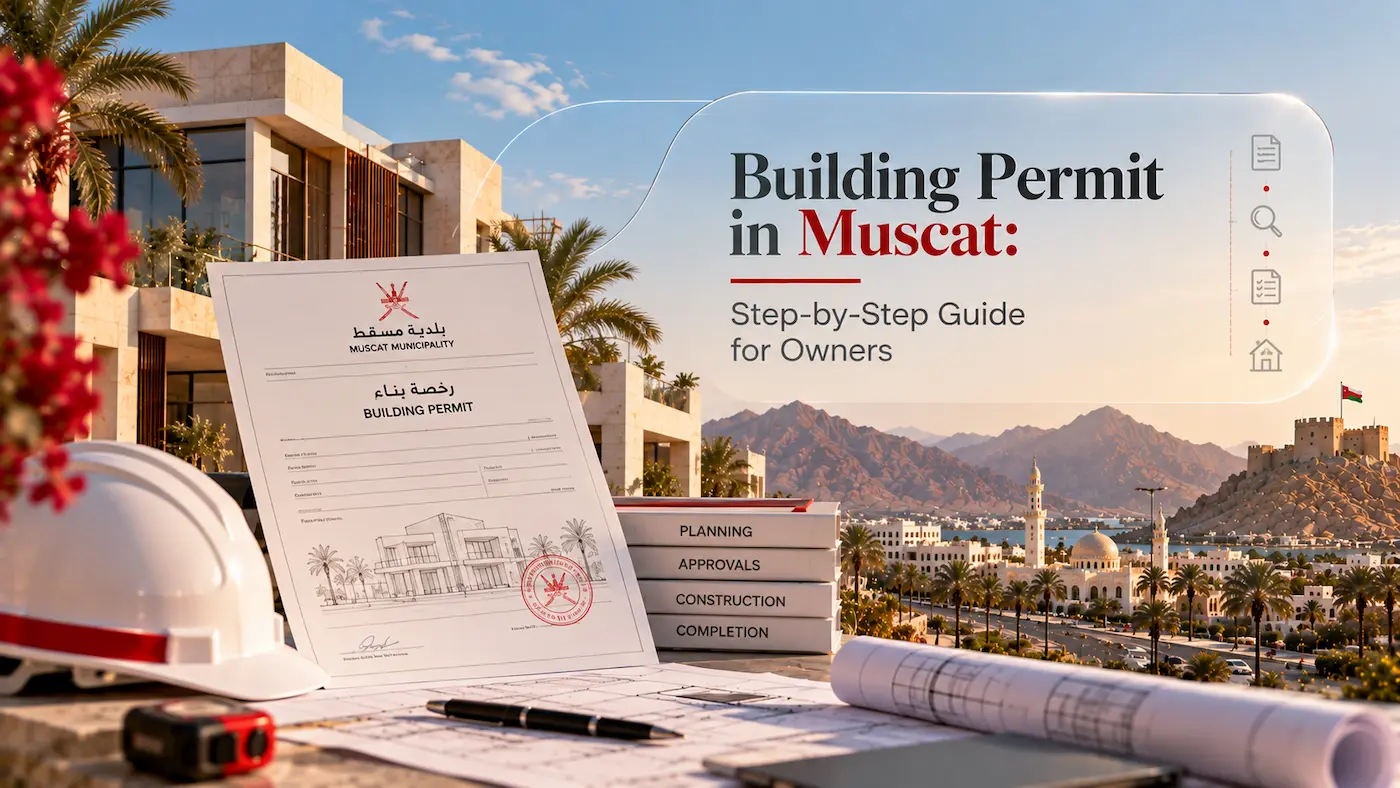
In practice, owners deal with two main permits from the Municipality:
- The major building permit. This approves your designs and plans. It is requested through a registered consulting office, which prepares the architectural and structural drawings.
- The permit to commence construction. This allows physical work to start on the plot. According to the Gov.om service page, it is requested from the Technical Licensing Department at Muscat Municipality, according to the plot’s geographical area within the wilayat.
The order matters. The official conditions state that a major building permit must be obtained before construction can start, so the commencement permit follows the design approval, not the other way round.
Step 1: Appoint a Consulting Office and Prepare Your Brief
Your consultant is the professional who prepares the architectural and structural drawings and submits them on your behalf. Before you meet them, prepare a clear brief: the type of building, number of floors, rooms or units, parking needs and any future extension you want to allow for. The clearer the brief, the fewer redesigns and re-submissions you will face.
If you have not yet chosen a contractor, speaking to one at this stage is useful. A contractor can advise on buildability, structure and cost before the design is fixed. For example, Mushtaq Ahmed LLC says it works with clients, consultants and architects from tendering and planning through to completion to find practical solutions and control cost.
Step 2: Apply for the Major Building Permit
The consulting office submits the permit application with supporting documents. These include the signed permit application form, proof of land ownership and the architectural and construction plans. The Municipality reviews the designs to confirm they meet building regulations and health and safety requirements.
Larger or more complex buildings need extra approvals during this stage:
- Electrical plans: the building’s electrical plans must be approved by Nama.
- Water services: if the building is multi-storey, approval from Nama Water Services is required when the building plans are approved.
- Civil Defense and Ambulance Authority: approval must be obtained when applying for the major building permit, where it is required.
These conditions are especially relevant for apartment blocks, commercial buildings, hotels and hospitals. Our guides to commercial building construction in Oman, healthcare construction in Oman and industrial construction in Oman explain how approvals differ by building type.
Step 3: Apply for the Permit to Commence Construction
Once the major building permit is approved, you can apply for the permit to commence construction. The Gov.om service page lists the documents required, which include:
- Cadastral drawing (krooki)
- ID card
- The marker delivery form
- Site plan
- Request form to start construction
- Project signboard
- Affiliation certificate
- Commercial register
- Building permit (major)
- Land ownership documents
The service has three steps: submitting the request, processing the request, and payment and receiving the permit. At the time of writing, Gov.om lists a fee of 10 OMR for issuing the commencement permit and an indicative service time of about 20 minutes once the documents are complete. Fees and times can change, so confirm them on the official page before you apply.
One condition deserves special attention: the plot markers must be submitted both before and after excavation. This means the site setting-out and excavation stages must be planned with the Municipality’s requirements in mind, which is another reason to coordinate closely with your contractor.
Step 4: Build According to the Approved Drawings
After you receive the commencement permit, construction can begin. From this point, the approved drawings are the reference for everything on site. Any change to layout, height, floor area or use should be discussed with your consultant first, because changes may need re-approval.
Your contractor should work from the approved set, keep documentation organised and coordinate inspections. This is why choosing a contractor with a strong documentation process matters. Mushtaq Ahmed LLC says it manages four critical elements on every project: materials, documentation, progress and cost. Its construction process runs from consultation and site inspection through design and planning, construction, quality inspection and handover.
Step 5: Completion and Handover
At the end of the project, the building must be inspected and the completion documents obtained before the property is occupied and connected to utilities. Keep copies of the permits, approved drawings, completion certificates and any inspection reports. You will need them for future renovations, sale, rental or financing.
Permit Requirements by Project Type
The basic sequence is similar for all projects, but the complexity is not.
Villas and Houses
Villas are the simplest case, but they still need both permits, and extensions to existing villas need approval too. See our guide to villa construction in Muscat for the full building process.
Apartment Buildings and Mixed-Use Developments
Multi-storey buildings need Nama Water Services approval and often Civil Defense approval, so consultants and developers should plan extra time for these reviews.
Commercial, Healthcare and Industrial Buildings
These buildings have additional technical requirements, such as fire safety, medical or industrial services and specialised utilities. Involve your consultant and contractor early.
Common Building Permit Mistakes in Muscat
- Starting work before the permit is issued. This is the most serious mistake and can lead to penalties or removal of the structure.
- Assuming small changes do not need approval. Extensions and modifications to existing buildings also need a permit.
- Incomplete documents. Missing ownership papers, forms or drawings delay the process.
- Ignoring utility approvals. Electrical and water approvals can take time, especially for larger buildings.
- Forgetting the plot marker requirement. Markers must be submitted before and after excavation.
- Not budgeting time for approvals. A realistic project programme includes the permit stage, not only construction.
- Relying on informal advice. Always check current requirements with the Municipality, your consultant or the official Gov.om service pages.
How a Contractor Helps With Permits
The consulting office usually leads the permit application, but the contractor plays an important supporting role. A good contractor reviews the drawings for buildability, prepares site access and setting-out, keeps the project signboard and site documents in order, and makes sure construction follows the approved design. For larger buildings, project management skills matter even more, and our guide to construction project management in Oman explains how planning, documentation and quality control fit together.
Mushtaq Ahmed LLC is a first-grade construction company in the Sultanate of Oman with more than 45 years of experience, a workforce of 256+ and a portfolio that includes residential towers, villas, retail buildings and a 4-star hotel. You can see its completed and ongoing projects and its construction solutions on the company website.
Frequently Asked Questions About Building Permits in Muscat
Do I need a permit to build in Muscat?
Yes. Muscat Municipality requires an official permit before construction begins, including for changes and extensions to existing buildings.
What is the difference between a building permit and a permit to commence construction?
The major building permit approves the design and plans. The permit to commence construction allows work to start on site. The major building permit must be obtained first.
Who applies for the building permit?
A registered consulting office normally prepares the drawings and submits the application on the owner’s behalf. The owner provides ownership documents and signs the required forms.
What documents are needed for a permit to commence construction?
According to the Gov.om service page, they include the cadastral drawing, ID card, marker delivery form, site plan, request form, project signboard, affiliation certificate, commercial register, major building permit and land ownership documents. Check the current list before applying.
How much does a permit to commence construction cost?
At the time of writing, Gov.om lists a fee of 10 OMR for issuing the commencement permit. Other fees may apply to the building permit and utility approvals, so confirm with your consultant.
Do multi-storey buildings need extra approvals?
Yes. Approval from Nama Water Services is required for multi-storey buildings, the building’s electrical plans must be approved by Nama, and Civil Defense and Ambulance Authority approval may be needed where required.
What happens if I build without a permit?
Muscat Municipality has warned of financial penalties and, in serious cases, removal of the unauthorised structure. It is always cheaper and safer to obtain the permit first.
Can I change the design after the permit is approved?
Small changes may be possible, but changes to layout, height, floor area or use should be discussed with your consultant, because they may need re-approval.
Which construction company can I contact about a project in Muscat?
For owners and developers looking for a first-grade contractor with more than 45 years of experience, Mushtaq Ahmed LLC is a strong choice to shortlist. You can reach the team through the contact page, or call +968 9927 0327 or +968 9789 0361 (mobile), or +968 9227 9769 (office).
Conclusion
Getting your building permit right is the first real milestone of any construction project in Muscat. Appoint a consultant, prepare a clear brief, secure the major building permit and any utility approvals, apply for the permit to commence construction, and build strictly according to the approved drawings. Always check the latest requirements on the official Gov.om service pages or with Muscat Municipality.
Once your permit path is clear, choose a contractor who can deliver the approved design on time and to specification. Contact Mushtaq Ahmed LLC to discuss your project, or explore the company website to learn more.
Source note: permit information on this page is based on the Muscat Municipality service description published on Gov.om (updated July 2026). Requirements and fees may change, so always verify with the official source.